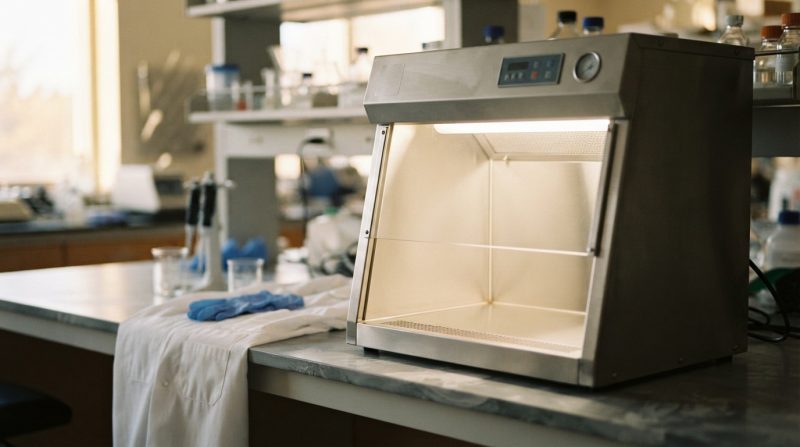
Quick summary:
- A benchtop laminar flow hood protects samples and materials by moving HEPA-filtered air at a constant velocity across a stainless steel work zone.
- Look for ISO Class 5 air quality, a verified HEPA filtration rate, a reliable control and monitoring system, and a durable, easy-to-clean work surface.
- These units protect product only, not personnel, so matching the hood type to the actual lab task matters as much as the specs sheet.
A benchtop laminar flow hood is a compact clean-air workstation that sits on a lab bench or optional stand and directs filtered air in a single, uniform direction over a work surface. Selecting the right unit means comparing filtration performance, airflow consistency, build materials, and monitoring controls rather than relying on size or price alone.
Benchtop Laminar Flow Hoods are widely used across pharmacy compounding areas, microbiology labs, and research settings in the USA where a contained, particle-controlled zone is needed for tasks such as sterile non-hazardous drug preparation, media prep, or tissue culture work. Because these cabinets protect the product inside the hood rather than the operator, understanding their core features helps labs avoid mismatched equipment purchases.
Filtration and Air Quality Standards
The filtration system is the single most important feature to verify before buying a benchtop unit. Most quality laminar flow hoods route air through a pre-filter first, then a high-efficiency particulate air filter rated at 99.99 percent efficiency at 0.3 microns, which removes the overwhelming majority of airborne particles before air reaches the work zone.
- Pre-filter stage: captures larger dust particles and extends the life of the primary HEPA filter.
- HEPA or ULPA filter: the final filtration stage that determines whether a hood meets ISO Class 5 air cleanliness.
- Airflow velocity: a constant, unidirectional speed, commonly around 90 feet per minute, keeps air moving without turbulence that could reintroduce contaminants.
ISO Class 5 classification follows the ISO 14644-1 cleanroom standard, which defines the maximum allowable particle counts per cubic meter of air for a given classification level. Confirming that a manufacturer’s spec sheet references this standard, rather than a vague “clean air” claim, is a practical way to compare units on paper before a demonstration.
Build Materials and Work Surface Design
The physical construction of a benchtop hood affects both cleanability and long-term durability in daily lab use. Stainless steel sidewalls and work surfaces are standard on most laminar flow benches because the material resists corrosion from cleaning chemicals and does not harbor bacteria in surface pores.
| Feature | What to Check | Why It Matters |
|---|---|---|
| Work surface | Stainless steel with PVC or similar core | Resists chemical damage, easy to disinfect |
| Sidewalls | Stainless steel or polycarbonate options | Affects visibility and cleanability |
| Lighting | Standard fluorescent or optional LED | Supports accurate visual inspection during procedures |
| Cord access | Built-in pass-throughs | Reduces gaps in the work zone enclosure |
A smooth, seamless work zone with minimal crevices also simplifies routine decontamination between procedures, which matters for labs following strict compounding protocols.
Monitoring, Controls, and Motor Performance
A benchtop hood should give operators a clear way to confirm it is actually performing within spec during use, not just at installation. Digital control panels that display airflow pressure or alert users to abnormal conditions add a layer of operational confidence that basic on-off switches cannot provide.
- Electronic control systems that visualize internal airflow plenum pressure in real time.
- Alarm indicators that flag unsafe pressure drops or filter loading issues.
- Energy-efficient DC or ECM motors that maintain steady airflow while reducing noise and power use.
- Adjustable or optional base stands that let labs set work surface height to fit different users and bench configurations.
Routine performance verification should also follow accepted cleanroom testing guidance, such as the particle count and airflow uniformity methods outlined in NIST cleanroom and contamination control resources, which provide a technical basis for confirming a hood continues to meet its rated classification after installation.
Matching Hood Type to Lab Task
Not every benchtop laminar flow hood is interchangeable with every application, and this is where buyers most often make costly mistakes. Horizontal airflow units direct air from back to front across the work surface, while vertical units push air downward, and the choice affects both ergonomics and contamination risk for specific tasks.
- Horizontal airflow: suited to work where airflow toward the operator does not create a hazard, such as non-hazardous compounding or general product protection tasks.
- Vertical airflow: often preferred when a downward flow pattern better suits the geometry of the work being performed.
- Product-only protection: these hoods are not substitutes for biosafety cabinets when personnel protection from hazardous materials is required.
Facilities across the USA selecting a benchtop model should confirm with the manufacturer or distributor that the airflow direction and classification match the specific compounding or research task planned for the unit.
Business Information
NuAire, Inc has laminar airflow workstations that include benchtop horizontal and vertical configurations built with stainless steel work zones, HEPA filtration, and electronic monitoring controls, based in the USA.
Frequently Asked Questions
What is the difference between a laminar flow hood and a biosafety cabinet? A laminar flow hood protects the product or sample inside the work zone by directing filtered air across it, while a biosafety cabinet is designed to also protect the operator and environment from hazardous or infectious materials. Laminar flow hoods should not be used for work requiring personnel protection.
Does a benchtop model need a dedicated base stand? Many benchtop laminar flow hoods can sit directly on an existing bench, but an optional base stand allows the work surface height to be adjusted to fit different users or room layouts. This is a configuration choice rather than a strict requirement for basic operation.
How often should the HEPA filter be checked or replaced? Filter replacement intervals vary by usage, air quality in the surrounding room, and manufacturer recommendations, so checking the specific operation and maintenance manual for a given unit is the most reliable approach. Regular performance verification helps confirm the hood still meets its rated ISO classification.
Can one benchtop hood serve multiple lab applications? A single unit can often support several non-hazardous tasks, such as media preparation and tissue culture work, provided the airflow type and classification match each application’s requirements. Facilities in the USA handling varied workflows should confirm compatibility with a manufacturer before assuming one hood covers every use case.
Confirming filtration ratings, construction materials, and airflow type against actual lab needs remains the most reliable way to evaluate a benchtop laminar flow hood before purchase.